
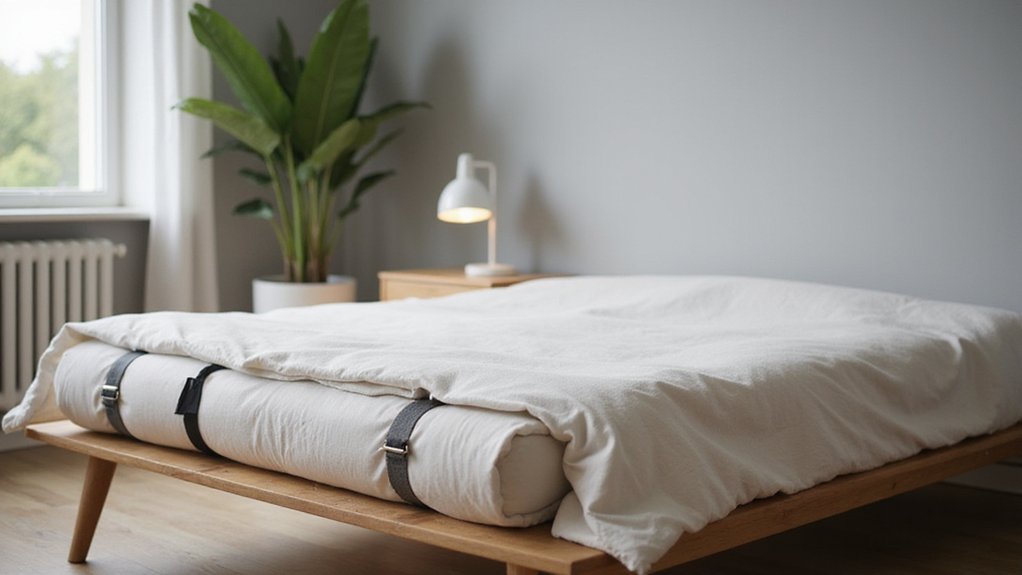
If your mattress feels like it’s sagging or not providing enough support, you might be wondering what can help. A bunkie board is a slim, sturdy base that sits between your mattress and bed frame to improve support and prevent sagging.
It’s a simple, lightweight solution that can make your bed more comfortable and last longer.
Keep reading to see if it’s what your bed needs.
What Exactly Is a Bunkie Board?
A bunkie board is a low-profile, rigid foundation for your mattress, typically measuring between 1 and 3 inches thick. It’s made from engineered wood, plywood, or metal, and often wrapped in a non-slip fabric cover for a tidy appearance. Its main function is to create a flat, solid surface between your mattress and bed frame, preventing sagging by bridging gaps in slatted or wire-grid foundations. This results in more uniform support that’s usually superior to traditional slats. The bunkie board also helps maintain a sleek, modern look by keeping the mattress close to the ground. With various height options available, you can easily customize your bed’s profile without sacrificing support. Its rigidity ensures even weight distribution and helps maintain proper spinal alignment throughout the night. It is often used when a foundation alone is insufficient to provide adequate mattress support. For a queen mattress, the board must match the exact dimensions of queen size to ensure a proper fit.
Why Use a Bunkie Board Instead of a Box Spring?
A bunkie board offers a low-profile, rigid foundation that sits just 2 inches tall, making it a practical alternative to a traditional box spring. It can save you up to 50% in cost, making it ideal if you’re on a tight budget or want to avoid the expense of a box spring. Its lower height benefits shorter individuals, children, or older adults who may find it easier to get in and out of bed. The firm, even support it provides prevents mattress sagging, especially for memory foam or latex mattresses. This firm support also allows for better airflow, which can enhance the cooling performance of a memory foam mattress topper. Plus, because it’s lightweight, you can move and install it easily without heavy lifting or tools. Unlike a mattress pad, a bunkie board does not add plushness, but it ensures a stable base that works well with any mattress topper. Overall, it’s an affordable, stable option that simplifies setup while maintaining good support. For older wooden beds or sleigh beds that lack sufficient support, adding a bunkie board provides a rigid foundation that prevents the mattress from sagging. Compared to a box spring, a bunkie board often results in lower cost savings for the user.
Which Beds and Mattresses Work With a Bunkie Board?
Bunkie boards work best with platform beds that have slat gaps exceeding 3–4 inches. They bridge these gaps, providing a solid, uniform surface for your mattress. Bunkie boards are especially beneficial in bunk bed setups, where they add around 1.5 inches of height, helping maintain the required 5-inch guardrail clearance for safety. They are also useful for improving indoor air quality by preventing dust and allergens from settling between slats. They are well-suited for memory foam, latex, and hybrid mattresses because these types need a flat, non-flexing support surface. Traditional innerspring mattresses can also be compatible, particularly when height restrictions are a concern. Your bed frame must have slats or side rails capable of supporting the bunkie board securely. For added comfort, pairing a bunkie board with microfiber sheets can enhance the softness and breathability of your bedding setup. Opt for a bunkie board rated for your weight, ideally supporting over 500 pounds for heavier mattresses or shared sleeping arrangements. This ensures stable support without adding unnecessary height to your bed. Additionally, similar to how heated throws provide targeted warmth, a bunkie board offers targeted support by eliminating the sagging and flex that can make a mattress uncomfortable.
What Are the Downsides of a Bunkie Board?
A bunkie board does have its drawbacks. Wooden variants are susceptible to absorbing moisture in humid climates, which can cause warping and distort the shape over time. This not only compromises the board’s integrity but can also affect the overall support your mattress provides. Additionally, because bunkie boards lack elasticity, they do not offer the bounce or cushioning of a traditional box spring, resulting in a bed surface that feels notably firmer and more rigid. For those seeking a mattress that specifically alleviates back pain, a bunkie board’s firmness may actually be beneficial, but only if the mattress itself is designed for pressure relief and spinal alignment. In contrast, rock salt lamps are known for their ability to improve air quality through ion release, which may create a more relaxing environment that complements sleep quality. To maintain a fresh and healthy sleeping environment, it is equally important to follow regular cleaning routines for any humidifier used in the bedroom to prevent mold and bacteria buildup.
For taller individuals, the low profile of a bunkie board can make getting in and out of bed more difficult or uncomfortable. It’s also important to be mindful of weight limits; many standard bunkie boards cannot support heavy mattresses or users over 500 pounds. Exceeding these limits could lead to premature wear or even structural failure, so checking weight restrictions before purchase is essential. Furthermore, they cannot be used on adjustable bases, as this prevents the proper movement of the frame.
What Materials Are Bunkie Boards Made From?
Bunkie boards are commonly made from wood, plywood, particleboard, or steel. Solid wood provides excellent durability and high-demand support, making it suitable for heavier setups. Plywood offers better stiffness and resistance to warping because of its layered manufacturing process, preventing splitting under heavy loads. Particleboard, a budget-friendly option created from glued wood chips, is less durable and can warp or degrade in humid environments. Steel, often covered in fabric, is used for metal bunkie boards and provides high weight capacity along with good airflow through slat designs. It also tends to be more resistant to warping but isn’t ideal for use with memory foam mattresses. Many plywood or metal variants feature non-slip fabric covers to soften edges and secure the board in place during use. When choosing a material, consider durability, support needs, and the type of mattress you plan to use. For those comparing options, lamps and tables are different from bunkie boards but involve similar trade-offs in material cost and comfort for your room. For additional comfort, a mattress topper can be added on top of the bunkie board to soften the sleeping surface. Organizing your closet around these material choices can ensure your closet organization remains efficient and supports your bedding storage needs.
How to Choose the Right Bunkie Board for Your Bed
Start by measuring the interior length and width of your bed frame accurately. This ensures the bunkie board fits snugly without being too tight, which can cause squeaks or damage. Leave about a quarter-inch gap on each side to facilitate installation and reduce noise. Be mindful of obstructions like bolts or crossbars that can reduce usable space, and choose a thinner board for bunk beds to maintain safety rail height. Double-check your mattress warranty; if your slats are spaced too far apart, a bunkie board is often required to prevent voiding the warranty. Lastly, select a board that matches your mattress size and weight capacity. For example, a standard twin measures 38 by 75 inches, while a Queen is 60 by 80 inches. Always verify your frame’s exact dimensions before making a purchase. Keep in mind that a bed platform can offer a more cost-effective and supportive alternative to a traditional box spring, which may influence your choice. Following the same principle as installing a window air conditioner, accurate frame measurement ensures a snug fit and prevents common mistakes. A simple DIY humidifier project can also use precise sizing to ensure components fit securely and function effectively.