If you’re wondering whether to switch from traditional incandescent bulbs to LEDs, you’re not alone.
LED bulbs use up to 85% less energy and last up to 50 times longer, making them a popular choice for saving both money and hassle.
While they may cost more upfront, you’ll recoup the expense over time through lower energy bills and fewer replacements.
Keep reading to see how these options compare beyond just savings.
So, Which Light Bulb Should You Actually Buy?
LED bulbs are the best choice overall despite their higher initial cost because they offer significant long-term savings and safety benefits. Although they tend to cost more upfront than incandescent bulbs, they pay for themselves within about a year through reduced energy consumption. They also produce instant, bright light without generating much heat, reducing fire risk and making them more comfortable for enclosed fixtures. When selecting an LED bulb, always check its compatibility with dimmer switches if applicable, as some LEDs do not work well with older circuits. For those building custom closet shelving with integrated lighting, LEDs are ideal due to their low heat output and long lifespan. LEDs also offer a higher color rendering index comparable to incandescent light, though incandescent bulbs still provide a CRI of 100 for more natural color appearance. For best performance, look for bulbs labeled as dimmable LEDs if you plan to use them with a dimmer switch. When installing under cabinet lighting, for example, ensure the fixture is big enough for the bulb, much like checking queen mattress measurements before buying a bed frame.
Choose the right color temperature based on your needs: 2,700K provides a warm, cozy glow ideal for living spaces, while 5,000K offers a cooler, daylight-like brightness suitable for work areas. With a lifespan of approximately 25,000 hours or more, you won’t need to replace LED bulbs frequently. Plus, their efficiency of 80 to 90 percent means you waste less energy, and since they do not contain toxic materials, they are safer for your home and the planet.
Incandescent vs LED: Which Saves More on Your Electric Bill?
LEDs save you a significant amount on your electric bill—up to 85% less energy waste compared to incandescent bulbs. For five hours of daily use, replacing a 60-watt incandescent bulb costing about $17 annually with an LED reduces your lighting expense to roughly $1.70 per year. Although LEDs typically cost $3 to $5 upfront, compared to $1 for an incandescent, you recoup that difference in less than two years through energy savings. When you switch entirely, your yearly lighting bill can drop from around $60 to about $15. Pairing your LEDs with a smart home system to automate their operation and selecting a color temperature suited to the room—warm for cozy spaces, cool for work areas—maximizes efficiency. Over the lifespan of a single LED bulb, this strategy can save you over $1,600, making it a smart investment without any fluff. The startup energy surge is too minor to justify leaving lights on for savings, as turning off lights prevents unnecessary waste. A key factor in whether your lighting is visible and effective is the ceiling light placement, which determines how well the fixture illuminates the room. Choosing the right bed frame can similarly affect your sleep comfort and long-term cost just as much as your lighting choice does.
Why LED Bulbs Last 50 Times Longer Than Incandescent
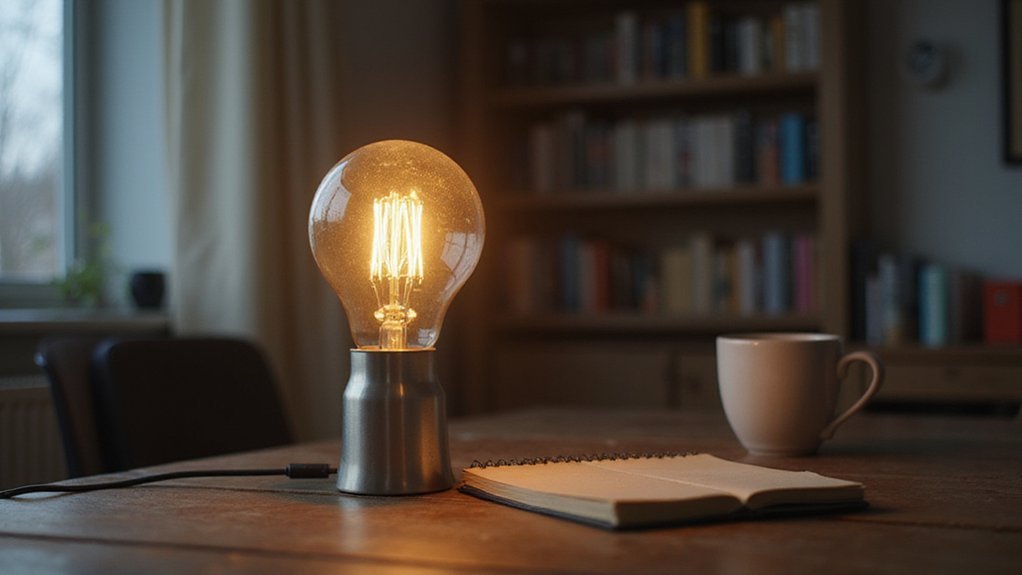
LED bulbs last 50 times longer than incandescent bulbs. While an incandescent typically lasts about 1,000 hours, an LED can go from 25,000 to 50,000 hours before needing replacement. This immense longevity results from their fundamental construction. Incandescent bulbs rely on a fragile filament made of thin wire that heats until it glows, but this wire gradually burns out. Vibration, voltage spikes, and everyday wear can cause it to break instantly. Just as a California King mattress caters to taller individuals, the LED’s design prioritizes durability without sacrificing efficiency. Similarly, the choice between percale vs. sateen sheet weaves hinges on different priorities for comfort and longevity.
In contrast, LEDs use a solid-state semiconductor component. When in use, electrons excite the chip, causing it to emit light without any moving parts or delicate filaments. This solid component is highly resistant to shocks, vibrations, and temperature changes, making it much more durable. As a result, you may buy dozens of incandescent bulbs during your lifetime but only need one or two LEDs to last for decades. For tasks requiring variable lighting levels, 3-way LED fixtures offer similar durability with adjustable brightness settings.
How Long Until an LED Bulb Pays for Itself?
Your payback period for an LED bulb depends largely on how often you use it. In high-usage areas like kitchens or outdoor lighting that run more than 8 hours a day, you can expect to recoup your investment in about 4 to 6 months. For typical household use of around 4 hours daily, the payback takes roughly 12 to 24 months. Swapping out a 60W incandescent for a 9W LED saves about $11 annually per bulb. Replacing 30 fixtures can save between $150 and $250 each year. Even if you opt for pricier dimmable or integrated smart lighting options, the math still favors LEDs because they reduce electricity costs by up to 80%. Overall, most homes see a full return on a $240 upgrade within just 8 months. Over their lifespan of 15 to 25 years, LEDs can pay for themselves five to ten times over. For example, in a house with 24 bulbs and an assumed energy cost of 30 cents per kWh, daily savings from 12 LEDs running 4 hours amounts to 48 cents. To maximize these savings, ensure your LED bulb is installed in a properly sealed window to prevent cool air from escaping and increasing runtime. Using budget-friendly materials from a DIY garment rack project can help you organize spare bulbs and tools efficiently.
Does LED Light Look as Good as Incandescent?
High-quality LEDs can achieve a CRI of 95 or above, bringing their color rendering closer to that of traditional incandescent bulbs. However, pay attention to the R9 value, which indicates how well red tones are rendered. Most standard LEDs score around 55 in R9, but for a more accurate and warm red glow, look for products with an R9 of 90 or higher. Even at the same color temperature of 2700K, LED light signatures differ from incandescent light; incandescent bulbs soften edges with their infrared falloff, creating a more natural, gradual transition. Many LEDs can feel hollow or less inviting in comparison, as their light tends to be more uniform and less nuanced. For authentic visual warmth and realism, simply relying on the correlated color temperature (CCT) number isn’t enough—you need to consider these additional metrics. Choosing the right lighting is as important as selecting the correct crib mattress size for a comfortable nursery. A proper silk pillowcase can further enhance the comfort of your sleep environment by reducing friction on hair and skin. Just as a down comforter requires careful cleaning methods to maintain its loft and insulating properties, incandescent bulbs deliver a unique light signature that many find more natural and inviting.
Are LEDs Safer and More Eco-Friendly?
LEDs are safer and more eco-friendly compared to traditional incandescent bulbs. Since they convert nearly all their energy into visible light rather than heat, they significantly reduce fire risks and can last up to 50,000 hours. In contrast, incandescent bulbs convert about 95% of energy into heat, making them a common cause of house fires. LEDs are also made from plastic or acrylic, which reduces the risk of glass shattering and causing injuries. Environmentally, LEDs use 70 to 90 percent less energy, lowering electricity costs and reducing greenhouse gas emissions from power plants. Their extended lifespan means fewer replacements and less waste, contributing to a more sustainable footprint. Safety-wise, LEDs contain minimal levels of arsenic and lead, making disposal safer. They emit very little blue light compared to natural sunlight and do not contain mercury, unlike compact fluorescent lamps. Overall, LEDs offer a safer, greener lighting option that outperforms incandescent bulbs in both safety and environmental impact.
How Incandescent and LED Bulbs Actually Create Light
LEDs create light through a process called electroluminescence. When electricity flows through a semiconductor material, it causes electrons to emit photons, producing light directly. Unlike incandescent bulbs that rely on heating a filament until it glows, LEDs generate light without any heat in the form of infrared energy. This efficiency means LEDs produce more light per watt consumed, stay cooler to the touch, and can last tens of thousands of hours. You get focused, energy-efficient illumination without generating excess heat or waste energy. In contrast, incandescent bulbs waste most of their energy as heat due to their low efficiency in converting electricity to visible light.