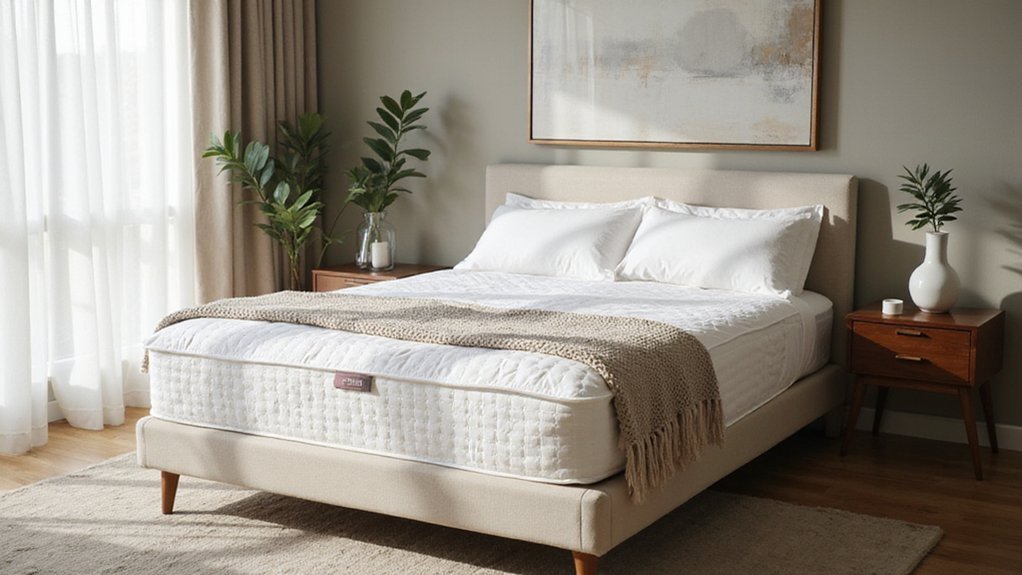
Are you trying to decide between a double and a queen mattress but unsure which fits your space and needs? The key difference is the extra six inches of width on a queen, greatly improving comfort for couples.
A double offers just 27 inches of personal space—less than a crib—while a queen provides 30 inches. This increase in width reduces partner disturbances by nearly half.
Keep reading to see which option best suits your room and budget.
Double Vs Queen: Why 6 Extra Inches of Width Changes Your Sleep
Because a double bed offers only 27 inches of personal space—about the width of a standard baby crib—those extra six inches on a queen (60 inches compared to 54) significantly enhance your sleep quality. With a queen, each person has 30 inches of space, reducing partner movement disruptions by approximately 47%. This extra width minimizes interference, allowing for more restful sleep. It also benefits the longevity of your mattress since less tossing and turning translates to less wear on the foam and coils over time. Bedding compatibility improves as well; queen-size sheets, blankets, and comforters fit properly without constant tugging or misalignment. The additional room prevents feeling cramped or rolling into your partner or off the edge, creating a stable, disturbance-free sleeping environment. For couples, investing in a queen means a more comfortable, restful sleep every night. Additionally, a queen mattress matches standard bed frames designed for that exact width, ensuring easy setup without gaps. For those with bulky bedding, checking the washing machine king comforter dimensions ensures your queen comforter can be properly cleaned without issues. When shopping for a queen, you also benefit from lower cost compared to king-sized options, making it a budget-friendly upgrade.
How Much Personal Space Do You Really Get on a Double vs Queen?
A queen-sized bed provides about 30 inches of personal space per person, whereas a double offers only 27 inches. That three-inch difference can make a notable impact on your sleep comfort, especially late at night. On a double, you’re limited to the minimum comfort zone; extending your arms at night risks bumping into your partner. A queen, however, allows enough space to sleep on your side with arms stretched out without disturbance. It also offers approximately 750 extra square inches of surface area, giving you more freedom to change sleeping positions without sacrificing comfort. The queen’s larger size accommodates independent movements better, especially with a memory foam mattress that molds individually. Additionally, the shorter length of a double—typically 75 inches—can force taller sleepers into a curled-up position, further reducing comfort. Overall, a queen provides a more spacious, livable setup, while a double tends to feel cramped. For context, when installing a unit into a window frame, measuring the exact width is essential to avoid common fitting mistakes. Before purchasing, consider that air purifier effectiveness can also impact sleep quality by removing airborne allergens. Choosing a cozy comforter that fits your mattress size is also key to achieving a comfortable bedroom setup.
Double vs Queen Room Sizes: When a Queen Won’t Fit
A queen bed measures 60 inches wide, so your room needs at least 24 inches of clearance on each side for easy movement. This means the room should be roughly 10 feet by 10 feet just to comfortably fit the bed and allow for basic navigation. In smaller spaces, a double bed is more practical, as it leaves more room for walkways and additional furniture like a dresser. For those who prioritize their grooming area, a vanity with lit mirror can also fit more easily in a room with a double bed, saving valuable floor space.
You also need to consider bed frame compatibility—a standard frame adds about 2 to 4 inches on each side, further reducing the available space. When comparing mattress firmness, remember that a double’s smaller surface limits how much you can spread out, but it offers a more livable layout in tight quarters. If your room measures under 9 feet by 9 feet, a queen bed will dominate the space, leaving little room for furniture or passage. In such cases, opting for a double bed helps maintain comfort and mobility without sacrificing too much sleeping area. For queen-sized sleepers, selecting a platform bed can minimize additional width compared to traditional frames. To further reduce visual clutter, pay attention to your ceiling light placement, as a poorly positioned fixture can make a small room feel even more cramped.
Why Couples Regret Buying a Double Bed Within One Year
A double bed quickly reveals its limitations for two people within a year. With only about 27 inches of personal space each, any movement or turn disturbs your partner’s sleep. This narrow space makes it difficult to sleep comfortably, especially if one of you tends to toss and turn. As months pass, the lack of room becomes more frustrating, leading to frequent disruptions and less restorative rest. This is part of a broader trend where one-third of couples now prefer sleeping alone to avoid such nighttime disturbances. Using a duvet cover can simplify washing and help regulate the bedding temperature more effectively. For those with persistent back pain, selecting a mattress with targeted lumbar support can significantly improve spinal alignment and reduce discomfort. However, if you are considering a bedroom renovation, remember that recessed lighting can help maximize the sense of space above a bed without sacrificing headroom.
Temperature comfort also becomes a problem. One partner’s body heat can raise the bed’s temperature well above the ideal 60–67°F range, causing both of you to wake up feeling too hot or sweaty. Constant jostling for space and temperature discomfort can lead to disrupted sleep patterns and fatigue.
Conflict surrounding sleep schedules or snoring also intensifies with a double bed. Without enough room to breathe or move away, these issues become nightly struggles. The limited space and comfort issues typically prompt couples to upgrade to a larger size, such as a queen or king bed, often within the first year.
Is a Double Mattress Best for Solo Sleepers and Teens?
A double mattress is a practical choice for solo sleepers and teens. It offers 54 inches of width, providing more space to stretch compared to a twin. This extra room can make a noticeable difference if you tend to move around during sleep or simply want more comfort. The 75-inch length accommodates most teens and adults under 6 feet, supporting full legroom without overwhelming a small room. Durability is another plus; well-made double mattresses can withstand years of nightly use. Many models also incorporate hypoallergenic materials, which benefit sensitive skin and minimize allergy triggers. Its compact size measuring approximately 4.5 by 6.25 feet fits well into smaller bedrooms, maximizing space without feeling cramped. If you want more room than a twin but prefer a manageable size, a double mattress offers an affordable and sensible option. Choosing a single or twin mattress instead may save even more floor space in a very tight room. To further reduce energy costs while heating a small bedroom, consider pairing your mattress with an energy-efficient space heater that uses targeted warmth rather than heating the entire room. For shared or guest rooms, building a bunk bed with this mattress size can maximize vertical space.
Double vs Queen Surface Area: Comparing the Full Sleeping Feel
A queen-size bed offers a noticeably more spacious sleeping surface than a double. The queen measures 60 inches by 80 inches, providing an extra 6 inches of width and 5 inches of length compared to the double, which is typically 54 inches by 75 inches. This change results in a 18% larger surface area—4,800 square inches versus 4,050 square inches—making a significant difference in comfort. With more room per person, about 30 inches each, you won’t feel as cramped when rolling over or shifting positions. If you use a memory foam mattress, the extra space allows the material to contour better without pressing into your partner. However, check mattress warranties: some manufacturers require at least a queen or larger for two sleepers to keep coverage valid. Considering everyday use, a queen also offers a wider comfort when sharing the bed, much like selecting the right lamp over a small table can improve functionality in a room. To maintain that fresh sleeping surface, regularly follow a safe cleaning guide for your bedding to prevent allergen buildup. For similar reasons, choosing the right bedding cover type can affect how easy it is to keep the bed clean and comfortable.
Double vs Queen Price: What You’ll Actually Spend
Expect to spend between $100 and $300 more for a queen mattress compared to a double in most brands. Entry-level options show smaller gaps of $75 to $150, while mid-range doubles priced at $500 to $850 typically jump to queens costing $650 to $1,100, reflecting a $150 to $250 difference. Premium models can have price gaps exceeding $300. Mattress materials influence these costs significantly; high-density foams and cooling gels that help regulate sleep temperature drive up the price of queens. For example, a Restonic ComfortCare double costs around $950, while its queen version is about $1,125—a $175 difference. The total setup including the mattress, frame, and bedding can range from $250 to $315 extra. Budget-friendly queen options start at approximately $300, but high-quality models usually fall between $500 and $700. Although the cost is higher, the additional space often justifies the investment. Similarly, 3-way LED bulbs can cost $5 to $15 more per bulb than standard dimmable LEDs, yet their adjustable brightness settings provide comparable value for versatile lighting needs.
Double vs Queen Bedding: Why Sheets and Frames Don’t Swap
Double and queen mattresses differ by 6 inches in width and 5 inches in length, so swapping sheets or frames between them won’t work. Queen sheets on a double bed will bunch up and slide off, since they are too large and won’t stay in place. The extra fabric creates loose spots that can be uncomfortable and hard to fix with bed firmness alone. On the other hand, double sheets leave the corners of a queen mattress exposed, which looks unruly and reduces comfort.
Frame compatibility is just as important. A double frame’s rails are typically 137 centimeters long, leaving about 6 inches of the queen mattress unsupported on each side. This sag not only impacts support but also makes the bed less stable. Using a queen frame under a double mattress creates a 6-inch gap, ruining the sleek, aligned appearance. To ensure your bedding fits securely and functions well, you need to match sheets and frames precisely to your mattress size. Mixing sizes compromises comfort and support, so stick with official dimensions for a perfect fit.
Can Two Adults Share a Double Bed Long-Term?
Sharing a double bed long-term is generally impractical for most adults. You only get about 27 inches of personal space each, which is less than a standard twin bed. If either of you is taller than six feet or has a larger frame, you’ll quickly feel cramped. Every movement you make will be felt by your partner, leading to frequent sleep disruptions and morning fatigue. For those who sleep spread out or toss and turn often, a double bed offers little room to breathe. Even light sleepers may find it hard to get comfortable over time. When considering alternatives, air purifiers help reduce allergens and improve overall air quality for better sleep. Bedding compatibility can also pose problems, as sheets designed for a double won’t fit larger beds like a queen. The bed frame must support consistent movement without creaking or loosening, which can be a concern with nightly activity. While petite couples who naturally sleep close together might manage, for most adults, sharing a double bed long-term is not a sustainable solution.
Double vs Queen: Who Should Buy Which Size?
A double mattress, typically measuring 138 by 75 inches, is suitable for single adults or teenagers. It provides 27 inches of personal space widthwise, offering enough room for movement without taking up too much space in smaller rooms. However, if you are taller than 5’9″, the extra length in a queen mattress, which measures 60 by 80 inches, becomes more comfortable as it prevents your feet from hanging off the edge.
For couples, a queen size is generally the minimum recommended. It offers 30 inches of width per person, which helps reduce disturbances from partner movement and allows side sleeping with arms extended comfortably. Queens are also the standard size for master bedrooms, so you’ll find a broader selection of firmness options and temperature controls.
Budget considerations matter too. A double mattress typically costs between $100 and $300 less than a queen, making it a more affordable choice for those with limited space or tight budgets. But keep in mind that doubles fit well in compact rooms, while queens require at least 10 by 12 feet of space for comfortable movement and use. When choosing, consider who will sleep there and the size of the room to ensure you get the best fit.