Are you wondering how cooling blankets keep you comfortable during hot nights? They work by using special materials that draw heat away from your skin, helping you stay cool and sleep better.
Whether it’s moisture-wicking fabrics or phase change materials, each tech targets overheating in a different way.
Keep reading to find out which cooling blanket might be best for you.
Why You Overheat at Night: and How Cooling Blankets Fix It
Because your body’s natural cooling system works against you at night, you often overheat due to a combination of environmental, biological, and behavioral factors. Your room’s high temperature prevents heat from dissipating effectively, especially when direct sunlight has warmed the space or if windows are kept closed, restricting airflow. Bedding materials like polyester or down trap heat, acting as insulators and preventing heat from escaping. Memory foam mattresses also retain heat because they lack proper air circulation, making it harder for your body to cool down. Additionally, sleeping positions such as curling into a ball can trap heat close to your skin, intensifying overheating. Choosing the right queen mattress size ensures proper airflow and reduces heat retention for a cooler sleep experience. To further improve airflow, consider installing a window air conditioner to actively cool the room and remove excess humidity.
Biological factors like hormonal fluctuations during certain times of the month or life stages can disrupt your body’s ability to regulate temperature. Pre-sleep habits such as consuming alcohol or spicy meals raise your core temperature, making it more difficult to stay cool through the night. Cooling blankets address these issues by prioritizing breathable, moisture-wicking materials that promote airflow and allow heat to escape. They help counteract the environmental and behavioral factors that cause sweating, creating a more comfortable sleep environment. While not designed to filter air, cooling blankets work alongside other effective strategies like reducing room temperature and improving ventilation to support your body’s natural cooling process.
Conductive Cooling: How Cooling Blanket Fibers Pull Heat Away
Cooling blankets work by transferring heat directly away from your body through conductive cooling. The effectiveness depends largely on fiber conductivity. Synthetic fibers like nylon have a thermal conductivity of up to 0.5 W/mK, which is nearly seven times higher than cotton’s 0.07 W/mK. This high conductivity allows heat to move quickly from your skin into the blanket fibers, helping to lower your body temperature. For comparison, heated throws and blankets operate on the opposite principle by actively adding warmth, making cost and comfort key differences when choosing between them. Advanced cooling blanket designs incorporate boron nitride nanosheets embedded into 3D fiber frameworks. This technology can boost overall conductivity to approximately 0.315 W·m⁻¹·K⁻¹ and reduce skin temperature by around 4.1°C. These conductive fibers prevent heat buildup by directly transferring your body heat into the surrounding air, but keep in mind that this process only works effectively when room temperature is below your body temperature. When ambient temperature exceeds your skin temperature, conduction cannot sustain cooling, and alternative methods may be needed, such as using a warm mist humidifier to manage moisture levels instead. When hanging the blanket for use, ensure you have the necessary tools and steps ready to avoid common installation mistakes.
Evaporative Cooling: How Sweat-Wicking Fabrics Keep You Dry
Evaporative cooling begins the moment you start to sweat, making it highly effective during physical activity. Sweat-wicking fabrics excel at moisture management by using capillary action to draw sweat away from your skin and spread it across the fabric’s surface. This promotes evaporation, which consumes heat energy to break hydrogen bonds in the moisture, consequently pulling heat from your skin and the surrounding air. As a result, you feel cooler and drier. For this process to work efficiently, the fabric must have good elasticity to stay in close contact with your skin, ensuring optimal sweat transfer. High-wicking polyester fabrics are especially effective at maximizing evaporative cooling during heavy sweating, while nylon offers quick relief during initial use. In dry environments, this process performs best, whereas high humidity can significantly slow down evaporation and cooling. For a more engaging hands-on demonstration, you can repurpose common household items to create your own lava lamp and observe similar heat-driven fluid motion. For a budget-friendly alternative, you might consider building a DIY hat rack to organize your gear while experimenting with cooling fabrics. To maintain consistent cooling overnight, some users pair this effect with a heated mattress pad that actively regulates temperature, though sweating should ideally be avoided during sleep.
Breathability: How Loose Weaves Prevent Overheating
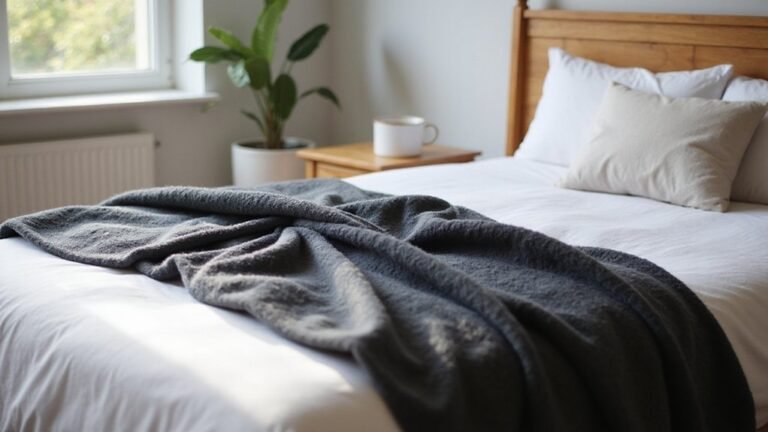
Loose weave blankets prevent overheating by allowing heat to escape through their open structure. The looseness creates air pockets that promote airflow, letting your body heat dissipate rather than get trapped beneath the fabric. This ventilation reduces insulation, making the blanket feel cooler even if it’s thicker. Breathable fabrics like linen and bamboo viscose enhance this effect naturally; linen’s hollow fibers wick moisture quickly, keeping you dry and comfortable. For those who also prioritize their beauty routines, a vanity with lit mirror offers similarly effective temperature regulation through its cool, glare-free LED lighting. Proper quilt construction also relies on similar principles of layering and spacing to manage heat and moisture effectively. A bedding coverlet uses a similar open weave structure to promote airflow and prevent heat retention in a cozy bedroom setup.
Tight knits or high thread count fabrics, by contrast, trap heat and restrict airflow. Even a thicker linen blanket with a loose weave can feel cooler than a thin polyester one because its open design prevents heat buildup. Choosing a blanket with loosened weaves ensures sweat evaporates efficiently as vapor, not liquid, helping you stay comfortable throughout the night.
Phase Change Materials: How Cooling Blankets Absorb Body Heat
Microscopic polymer capsules, ranging from 2 to 10 micrometres in size, are embedded into the fabric of the cooling blanket. When you sleep and your skin heats up, it triggers the phase change material (PCM) to melt. This process absorbs excess heat, helping to keep the fabric surface cooler throughout the night. The PCM continues to melt and absorb heat for several hours, but once it becomes fully liquefied, it stops functioning until recharged. To reset its cooling ability, simply allow the blanket to cool down—this causes the PCM to solidify again, preparing it for the next cycle of heat absorption. For a truly comfortable sleep surface, a mattress topper can similarly regulate temperature by adding an insulating layer. Similarly, a full sheet set will not fit a queen bed due to significant differences in mattress depth and dimensions. Choosing a bed frame without a platform can also affect airflow and cooling, unlike a solid platform design.
Gel-Infused Fibers: Passive Heat Absorption in Action
Gel-infused fibers pull heat away from your body immediately upon contact. Their high thermal conductivity allows the gel’s heat to transfer quickly from your skin to the fiber structure through microencapsulated particles. These particles absorb warmth passively, without melting or changing phase, acting like tiny heat sinks within the fabric. This passive heat absorption method is similar to sateen cotton sheets which use a specific weave to create a smooth, comfortable surface for sleep.
The fiber network inside the blanket disperses this absorbed heat across a larger surface area, preventing hot spots from forming. Because the gel acts as an efficient heat sink, the surface of the blanket stays 1 to 3 degrees Celsius cooler than standard materials. This results in instant, continuous cooling without dampness, providing a comfortable and consistently cool sleep surface.
Which Cooling Blanket Technology Works Best for Night Sweats?
Active cooling technologies like Phase Change Materials (PCMs) are the most effective for night sweats. PCMs absorb excess body heat as they shift from solid to liquid, providing an active thermal buffer that prevents overheating. This dynamic heat regulation surpasses passive options such as gel-infused fibers, which only slow heat transfer without actively controlling temperature. For example, a soft brush is recommended to gently remove dust from delicate fabric surfaces without damaging the material.
Layering these materials enhances their performance. A moisture-wicking top layer pulls sweat away from your skin, while the PCM-packed middle absorbs heat. The bottom layer encourages breathability, preventing heat buildup. Combining PCMs with high thermal conductivity fibers ensures rapid heat dissipation and sustained temperature regulation.
This integrated approach directly targets night sweats by actively managing your microclimate throughout the night. It offers continuous, responsive cooling that passive blankets can’t match, helping you achieve uninterrupted rest.